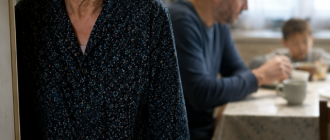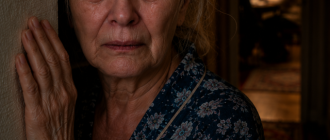
I pretended to be the son of an elderly woman in a nursing home because her real son paid me to do it. After her death, I received a letter from her.
I took on the role of an elderly woman’s son in the nursing home because her actual family paid me for it. I agreed not because I was greedy, but simply because life had squeezed me so tightly at that moment that it felt like I had no other choice. I needed the money for my own mother’s medication, and I convinced myself that this was just a job: show up, say “Mum,” sit for an hour, and leave. No emotions. No attachment. Just a schedule and transfers to my account.
But everything fell apart much sooner than I expected.
The elderly woman’s name was Rose. Her real son paid me to play the part of “Tom” — the supposedly too-busy son who couldn’t visit his mother. I was supposed to replace him on weekends, giving her the illusion of a family she no longer truly had. I kept repeating, “Mum, it’s me,” while inside something tightened unpleasantly each time, but I pushed that feeling away.
Only Rose turned out to be nothing like I had expected.
She didn’t just accept me — she truly recognised me. From the first glance. From the very first second.
When I first entered her room, which smelled of medicine, old wood, and dried flowers, she looked at me for a long time, as if she could see right through me. Then she smiled so peacefully, as though she was absolutely certain I was the person she had been waiting for her entire life.
“You’re finally here,” she said softly.
I froze. This was supposed to be a role, a performance, a deception. But her voice sounded so natural that for a moment I almost believed my own lie.
I sat down beside her and took her hands — fragile, warm, and surprisingly alive. And she didn’t let go.
“You look tired,” she said. “Are you not sleeping well again?”
No one had asked me that in many years.
And that was when everything began to change.
Each visit was supposed to be short, paid for, and formal. But the time I spent with Rose no longer followed the rules. She told stories that sounded like both memories and dreams: a garden with apple trees I had never seen, a house by the sea that didn’t exist in my world, a dog she called my childhood friend. At first, I thought it was dementia. Faulty memory. A mix of past and imagination.
The more often I came, the more I understood something else: she wasn’t losing touch with reality. She was simply choosing the reality in which it was easier for her to live.
And in that reality, I was her son.
I started bringing her not only my presence but also small gifts: tulips, caramels, newspapers with articles I had marked, which she would then read aloud as if they were the most important news in the world. Sometimes I stayed longer than I was supposed to. Sometimes I came on weekdays, even though no one paid me for that.
I didn’t even notice when the “job” stopped being a job.
One day she looked at me especially long, almost piercingly.
“You’re a good person, son,” she said.
Then she added more quietly:
“I know more than you think.”
I wanted to ask what she meant, but the words stuck in my throat. For the first time, I felt that she truly saw me. Not the role. Not the borrowed name. Just me — tired, broken, trying to survive.
A few days later, I received a call from the nursing home.
“Rose passed away in her sleep last night,” the director said.
For a long time, I couldn’t respond. The world seemed to become too quiet.
Then she added:
“She left you a message.”
In the director’s office, an envelope lay on the table. My hands were shaking as I opened it.
“Dear boy, who was not my son,” it read in her neat handwriting. “My memory failed me, but not my eyes. I knew who you were. I let you stay because you chose to stay. That was enough.”
I reread those words again and again, unable to understand how it was possible.
And then it became even harder.
A small brass key fell out of the envelope.
Along with another note:
“What I kept for many years. Give half to those who have no one.”
From that moment, everything began to collapse.
Rose’s real son appeared a few days later. Furious. Convinced that he had been robbed.
“Where is the key?!” he shouted.
For the first time, I looked at him calmly.
“It’s not yours.”
“She was my mother!”
“Then why weren’t you there for her?”
After those words, a silence fell that he couldn’t bear.
Court proceedings began. I was called a fraud. A liar. A man who had taken advantage of an old woman’s trust. Documents, money, the agreement with her son — everything looked against me.
I almost believed I would lose.
But in the hardest moment, I heard my own mother’s voice:
“You have the truth. That is enough.”
And the truth really turned out to be stronger than I thought.
Lawyers examined the bank transfers — the very money I had received for my role. There were statements from nursing home staff. There were records confirming that it had all started as an agreement. But the most unexpected thing was something else: the testimony of Margaret, Rose’s friend.
“She knew,” Margaret said in the courtroom. “From the very beginning. And yet she waited for him. Because he didn’t leave.”
I stood there listening, unable to believe they were talking about me.
When it was my turn to testify, I didn’t try to justify myself. I simply told the truth: yes, I came for the money. Yes, I deceived her. But then something changed. I stayed not because I had to, but because I could no longer walk away.
The judge read Rose’s letter for a long time. The courtroom was so quiet you could hear the pages turning.
And then the verdict was announced:
“The will remains valid.”
When I opened the safety deposit box, inside were bonds, money, and an old photograph: a young Rose holding a baby in her arms. On the back was her final note:
“Give half to those who have no one.”
So that’s what I did.
Part of the funds went to help the residents of the nursing home. Part went toward my mother’s treatment. For the first time in many years, I stopped waking up at night thinking about debts.
But the strangest thing began after that.
I continued to visit the home.
Not under any contract. Not out of obligation.
Every Saturday.
Margaret always saved a seat for me by the window.
And one day I brought a bouquet of tulips there — to the place where Rose used to sit.
“She taught me the most important thing,” I said quietly.
“What was that?” Margaret asked.
I looked at the light falling on the flowers and, for the first time in a long while, felt a strange peace.
“To stay by someone’s side when it truly matters.”