“Dad urgently called us to come over… we thought it was about the inheritance, but the truth turned out to be completely different.”
My name is Michael. I’m not going to tell you a story about how our father surprised us. I’m going to tell you how our family finally found its way back to each other.
Dad called each of us separately and said the same thing: “I need to tell you something important. Come this weekend.”
We all immediately assumed it was about the house or inheritance. There are four of us siblings. I’m 42, my older sister is 47, my brother is 38, and our youngest sister is 31. We had long since moved away and lived our own lives, only seeing each other on holidays — and not always then. Dad never complained. Mum passed away eight years ago, and he stayed alone in the big family house. We all silently decided that he was managing.
Recently he called us one by one with the same urgent request. We thought: what else could be so important that he wanted everyone together?
My sister called me first. Her voice was quiet. “You’re thinking the same thing, right?” she asked. “Yes,” I replied. We didn’t discuss it further.
My brother texted in the group chat: “I’m coming.” Our youngest sister sent just a dot. We all understood.
I drove for four hours thinking about how I had never told Dad that I loved him. Not because I didn’t — in our family we simply didn’t say such things. Mum showed love through food, through quiet gestures, through sitting next to you without words. Dad was silent. We had all adopted his language.
I decided: this time I would tell him.
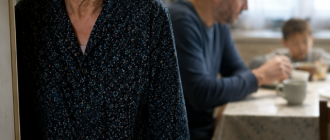
We arrived almost at the same time. Dad opened the door wearing a neatly ironed shirt buttoned all the way up. “Like he’s going to a funeral,” I thought, then corrected myself — like he was about to have a serious conversation.
There was a cake on the table. He had baked it himself.
We sat down. He poured the tea slowly, carefully arranging the cups. We waited. My sister held my hand under the table — something she hadn’t done since we were children.
“I’m selling the house,” he said.
Silence. Then my brother: “What?”
“I’m selling the house. I’ve found a buyer. In two months I’m moving out.”
We exchanged glances. This was the house where we had all grown up. The house where Mum had died. The doorframe in the kitchen still had the marks measuring our heights — the last one made the year she got her diagnosis and stopped noticing such things.
“Where are you moving?” asked our youngest sister.
He looked at her, then at each of us in turn. Slowly. As if checking whether we were ready.
“I’ve met someone,” he said. “Three years ago. I wanted to tell you many times. But you’re all so busy, and I didn’t know how… We want to live together. She has a flat. It’s small, but it’s enough for us.”
Three years.
He had hidden it for three years. He called us every Sunday, asked about the grandchildren, work, and health — and never said a single word.
“Why didn’t you tell us?” my sister asked. Her voice was steady, but I knew that tone.
He was silent for a moment, then said something that still tightens my chest:
“I was afraid you would think I was betraying your mother. And I was afraid you would say ‘that’s great, Dad, we’re happy for you’ — and that would be the end of it. That it would become another reason not to visit.”
No one said anything.
Because he was right. Not about Mum — none of us would have thought that. But about the second part — that we would say “great” and return to our own lives — he was absolutely right, and we all knew it.
Our youngest sister stood up, walked over to him and hugged him from behind, just like she did when she was little. He wasn’t expecting it — I saw his shoulders tense, then relax.
“We want to meet her,” she said.
“She’s in the next room,” he replied.
We looked at the door.
“She’s been waiting for two hours,” he added, almost apologetically. “I asked her to wait until I told you.”
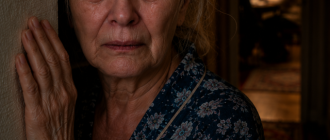
Her name was Grace. She was a petite woman with short grey hair, wearing a blue jumper. She stopped in the doorway, hands folded, her gaze calm but uncertain. The way people stand when they’re ready for any answer, because they’ve lived long enough to know that not everything in life can be controlled.
My brother stood up first and extended his hand.
“I’m David,” he said. “The second oldest and the most difficult as a child, if Dad told you.”
She smiled. Quietly, but genuinely.
“He did,” she said. “He told me about all four of you. A lot, and with great pleasure.”
We exchanged glances. Dad, who never talked — had been talking. Just not to us.
We sat until midnight. We ate the cake. Grace turned out to be a former school librarian who had read the same books as Mum, and it felt both strange and surprisingly natural. Dad watched us and stayed quiet — but it was a different kind of silence. Not his usual closed-off one. Lighter.
Before leaving, I stayed last. He walked me to the car. It was cold.
“Dad,” I said.
“I know,” he replied.
I didn’t manage to say anything more. He simply said “I know” — and I understood that he really did know. He had always known. We just didn’t talk about it in our family.
I sat in the car for ten minutes without starting the engine.
I thought about how much happens in the lives of the people we love while we’re busy with our own. Three years. He had been happy for three years, and we didn’t know. He had been afraid for three years, and we didn’t know.
We thought he was coping. He was coping. Just not alone, as we had assumed.